One of my friend sent me this info in the last years:
"FF7 remake had 2,315 developers"
I also saw similar information on Reddit about that and I was surprised by the number.
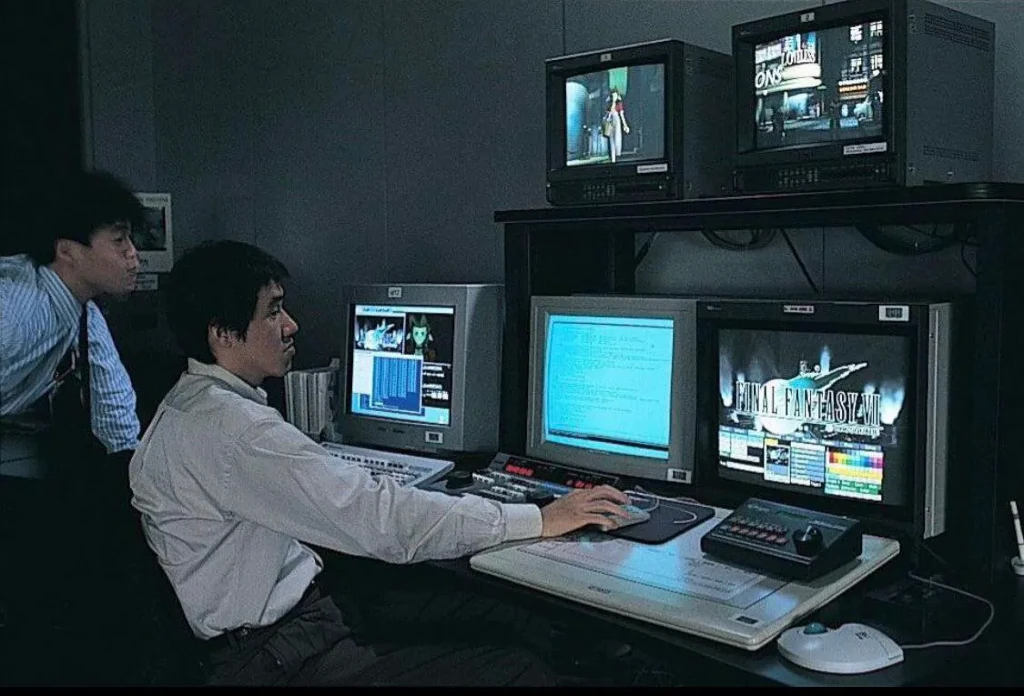
I like the Final Fantasy franchise and FF7 was the first in 3d. This game development was impressive (e.g. CGI studio in Hawaii).
So I decided to gather credits for some games and the best place for that is MobyGames!
MobyGames is like IMDB but for games. You can even find your name if you have ever worked in the gaming industry.
MobyGames provides an API to fetch data for games, genres, platforms, collections, ... I kept that very simple so I just "manually" fetched the credits part of some games by going directly to their web page instead.
It's a monkey job in that way and I just grabbed one credit information: "professional roles". It was nice to do and at the same time, I listened to some old Nobuo Uematsu songs.
Game development teams have grown massively over the years!
I didn't include every game in the franchise, only the most popular titles, remakes, and remasters.
The team size only includes "professional roles" and some counts may be outdated, incomplete or inaccurate (e.g. WoW: Mists of Pandaria) across certain platforms.
The ratio factor is a little biased because it uses the first released game as the baseline. Below is a separate comparison between selected original games and their remastered versions:
You've probably heard the term "AAA game" and its variations. These categories have no official definitions but here is a rough guide to how they are commonly used:
[AAAA]
- Bullshit Marketing!
[AAA]
- Blockbuster production with a massive development budget and worldwide marketing
- Team Size: 200-1000+
- Budget: $50-700+ Millions
- Hollywood style production with 3-7+ years of development, high-end graphics, large cinematics teams, extensive QA and releases across multiple platforms such as PC and consoles
- Games: Grand Theft Auto, Call of Duty, Assassin's Creed, The Last of Us
[AA]
- Mid-budget professional production with a more focused scope than most AAA games
- Team Size: 30-200
- Budget: $5-50M+
- AA sits between indie and AAA. It retains professional production values but generally has smaller teams and worlds, less content, more limited marketing campaigns and fewer target platforms
- Games: RoboCop: Rogue City, A Plague Tale, DayZ
[Indie]
- A melting pot from solo dev, small projects, Indie to Triple-I (Independent game with AA/AAA-like production values)
- Team Size: 1-5, 1-50, 20-100+
- Budget: Variable, $0-5M, $1-10M
- A relatively small, professionally developed commercial game with greater financial and creative independence, typically featuring a limited budget, fewer cinematics, less marketing and a smaller overall scope
- Games: Stardew Valley, Hollow Knight, Vampire Survivors
[AI Production]
Now the "Philosoraptor" question is: if a game developer uses AI during development, and that AI was trained on millions of pieces of content created by millions of people... does that technically make it a AAA game, since a huge number of people worked on it indirectly ????
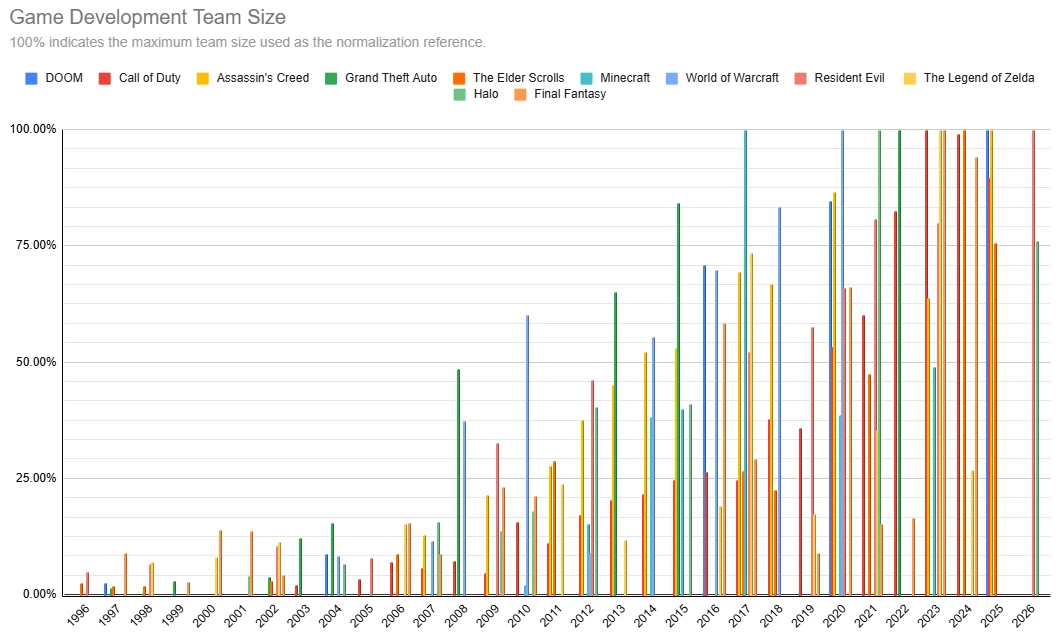
Below, I've aggregated all the data from the game franchises above into two graphs.
The first graph shows the developer count with each line representing a different game franchise.
The second graph uses one vertical bar for each released game with the bar color indicating its franchise.
An SVG file version of each graph is also available for a closer look.
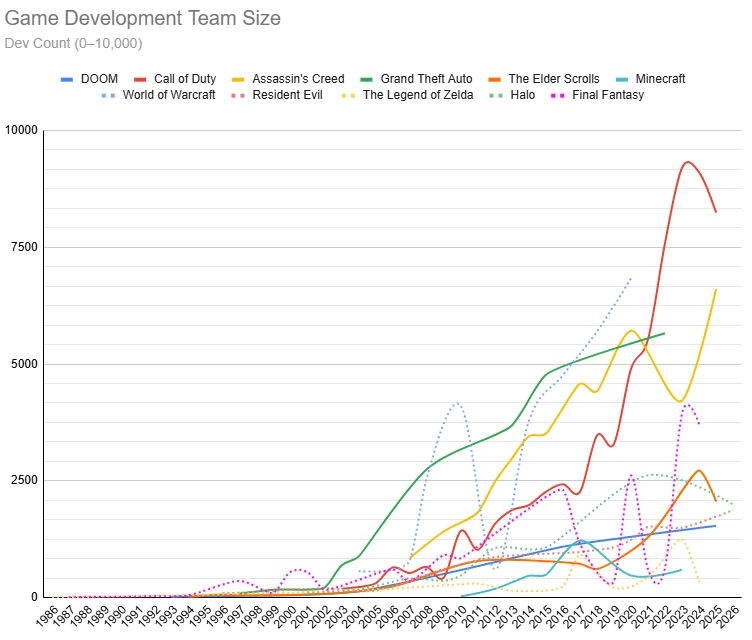
Depending on the franchise, development teams appear to have doubled, quadrupled or even grown several times larger each decade!
I wouldn't be surprised to see development team sizes shrink over time as the current scale may become unsustainable especially from a cost perspective.
And with the current trend of putting AI everywhere, many of these new tools (e.g. localization, scripts, auto-generation, ...) could help improve game developer productivity.
Maybe in the near or not so near future, we will get a new game term like Neo-Indie++: A game developed by a tiny team on a low-mid budget,
powered by advanced AI tools and topped off with some ridiculous mega AI post process (DLSS-1024 version)...
Sorry for the video in french above but I like the Q&A part.
The guy is a collectionner (full setter) with 15'000 games and 300 consoles and below are the 2 final questions he answered:
"And your collection, uh, at what generation does it stop? Like, what's my collection actually?"
"And now I'm going to make some enemies because I have the answer to when retro gaming ends. Retro gaming ends when games need updates to work (when games required mandatory updates or internet connections to function)."
"You, who have all the consoles, what's the best console ever in your opinion?"
"Well, the answer is biased. The best console is the one you had when you were 10 years old. That's the best console."
Well, it seems I'm not the only one thinking about developer counts and team sizes.
While writing this blog post, I came across a YouTube video by Laura Fryer called "The Invisible Layers Holding Games Back"
where she talks about modern game development teams, bureaucracy and uses the older original Halo game versus the more recent one as an example.
On my side, it was interesting to gather the data and statistics but the approach was still very simple ("professional roles" only).
I think it would be more interesting to split the credits into categories such as artists, QA, programmers, designers, managers...
And if we want to go deeper, we could also split the games between those using an in-house engine and those using a commercial engine.
"Usually", commercial engines like Unreal Engine or Unity are meant to offload part of the technical work and let the game studio focus more on other areas (e.g. gameplay).
I will stay curious about this topic and I would like to revisit it with an update in 5-10 years...
Thanks for reading,
JS.